


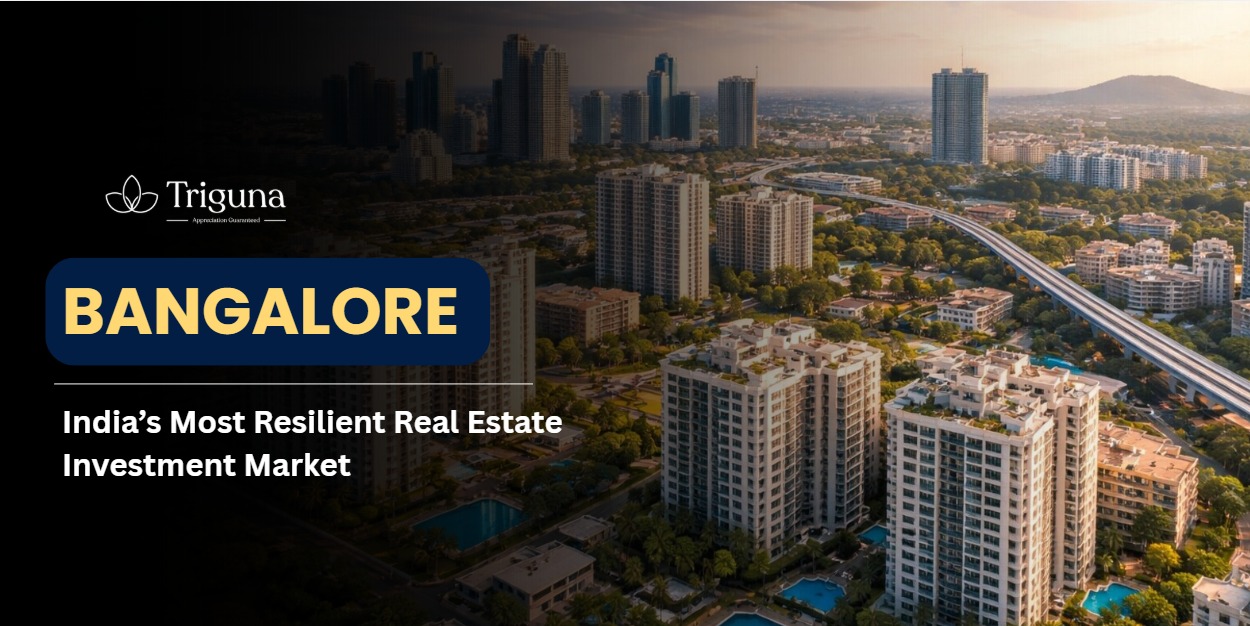
Why Bangalore Continues to Be India’s Most Attractive Real Estate Investment Market
Bengaluru’s real estate story is no longer just about being India’s tech capital. In 2026, the city has evolved into a well-rounded property market where residential demand, luxury living, retail expansion and even emerging segments like managed farmland are all growing in tandem.
While its strong IT backbone continues to drive job creation, the impact today is far more widespread. Premium housing markets are seeing steady appreciation, large-scale malls and high-street retail are expanding rapidly and peripheral zones are witnessing rising interest from buyers looking for plotted developments and lifestyle-driven investments.
The data reflects this broad-based growth. Bengaluru consistently contributes 30–35% of India’s total office leasing, while residential prices in key corridors have appreciated by 8–10% annually. At the same time, the city has seen a surge in Grade A retail developments, alongside increasing demand for second homes and farmland/farmhouses in nearby regions, driven by both lifestyle and investment intent.
What truly sets Bengaluru apart is this diversity. It is not just a city where people work; it is a city where people choose to live, upgrade, invest and build long-term assets across multiple real estate categories.
Here is a data-backed analysis of why Bangalore remains India’s most attractive investment market.
1. The Office-to-Residential Multiplier Effect
In any city, demand for housing closely follows the pace of job creation and office expansion. Historically, every 100 sq. ft. of Grade-A office space absorbed in the city eventually generates demand for approximately 1,000 sq. ft. of residential space.
In 2025,recorded nearly 20 million sq. ft. of office leasing in 2025, and even with global stabilization, projections for 2026 remain strong at around 15–16 million sq. ft.. This translates to an estimated 80–100 million sq. ft. of new residential demand, across multiple segments, entering the market by the end of 2026 as employees relocate to be near these new hubs.
Every office expansion creates a ripple effect. Let’s understand;
- Employees and professionals drive demand across mid-income, premium and luxury housing, including villas
- Migrant and young workforce fuels strong rental demand in IT corridors
- Long-term and high-income investors are turning to plotted developments, farmhouses and managed farmland for growth and lifestyle
- Growing population and commercial hubs boost retail, malls and high-street activity
This interconnected demand across segments is what makes Bengaluru more resilient than other cities. Unlike markets where growth is fragmented, Bengaluru benefits from a strong economic engine that feeds all real estate categories.
2. Residential Market: Strong Demand, Stable Growth and Reliable Returns
Bengaluru’s residential real estate market stands out because it is largely driven by end-users rather than short-term investors. This means most buyers are purchasing homes to live in, not just to flip for quick profits, making the market more stable and less prone to sharp ups and downs.
Key residential hotspots like Whitefield, Sarjapur Road and North Bengaluru have consistently seen 8–10% annual price growth, backed by steady demand and strong home sales. At the same time, the city maintains a healthy inventory overhang of around 10–12 months, which indicates a well-balanced market where supply is aligned with actual demand. Another major advantage is rental income. Bengaluru offers average rental yields of 3.5% to 4.5%, among the highest in India’s Tier-1 cities.
| City | Average Rental Yield (2026 Est.) | Key Driver |
| Bangalore | 3.6% – 4.5% | Youthful workforce & IT corridors |
| Mumbai | 2.0% – 2.6% | High capital entry costs |
| Gurgaon | 3.0% – 3.5% | Premium corporate leasing |
| Hyderabad | 3.0% – 3.5% | Expanding tech clusters |
Data Note: In high-demand micro-markets like Whitefield and the Outer Ring Road (ORR), yields have even touched 5% for studio and 2BHK configurations.
For investors, this creates a strong advantage, steady price appreciation combined with consistent rental income, making it one of the most dependable residential markets in India.
3. The Rise of Luxury and Lifestyle Real Estate
One of the biggest shifts in Bengaluru’s real estate market is the growing demand for luxury and lifestyle housing, largely driven by high-income professionals working in tech companies and Global Capability Centers (GCCs).They have a clear preference for:
- Larger homes with more space
- Gated communities with security and privacy
- Premium amenities like clubhouses, wellness zones and co-working spaces
- Branded and design-led residences
This demand is reflected in supply as well. Nearly 80% of new residential launches in recent quarters fall within the ₹80 lakh to ₹3 crore+ range, showing a strong shift toward the premium and luxury segments. Even with more new projects being launched, Bengaluru’s housing market remains balanced, with existing inventory expected to be sold in about 11 months which is much faster than cities like Delhi-NCR and Mumbai, where it can take 20–24 months.
4. Rise of Countryside Living, Managed Farmland and Plotted Developments
Alongside the growth of luxury housing in the city, there is a clear rise in demand for weekend homes and countryside living options on the outskirts of Bengaluru.
Post-pandemic, many buyers are looking beyond traditional apartments, not as primary residences, but as second homes where they can disconnect from city life and spend quality time with family and nature, especially over weekends. This has led to growing interest in options such as countryside plotted developments, farmhouses and managed farmland.
This demand is largely driven by high-income professionals, entrepreneurs, and long-term investors who are seeking a mix of lifestyle, sustainability and long-term value.
Locations like Nandi Hills, Devanahalli, Sarjapur outskirts and Kanakapura Road have emerged as key hotspots for these investments due to their accessibility from the city and greener surroundings.
A notable trend within this space is the rise of integrated weekend communities, where countryside plots or farmhouses are combined with hospitality-style amenities such as clubhouses, managed services and even international-standard resorts. This has elevated buyer expectations from owning simple farmland to investing in curated, community-driven lifestyle spaces.
“We are seeing a clear shift in how buyers are thinking about real estate today. It’s no longer just about owning a home in the city, but about creating a complete lifestyle. Hospitality-led countryside developments near Bengaluru are an emerging asset class that is already gaining strong traction, as they combine luxury, nature, and managed living in a way traditional real estate never did,” says Varun Kondareddy, Director at Triguna Projects.
Compared to other metro cities like Mumbai or Delhi-NCR where high land costs and limited green zones restrict such developments, Bengaluru stands out due to its accessible outskirts, favorable climate and availability of large land parcels, making it one of the most active markets for this segment.
5. Retail Boom: Malls, High Streets and Consumption Growth
Bengaluru’s real estate growth is also reflected in its expanding retail sector. Backed by a young, high-spending population and rising incomes, the city is seeing strong demand for Grade A malls, high-street retail and mixed-use developments. Areas like Indiranagar, Whitefield and HSR Layout continue to attract top brands, while new retail hubs are emerging alongside residential and office corridors.
This growth is closely linked to the city’s expanding workforce, more jobs and housing naturally drive demand for shopping, dining and entertainment. Retail in Bengaluru is now more experience-driven, blending lifestyle and social spaces rather than just traditional shopping.
Compared to cities like Mumbai and Delhi-NCR, where retail is more saturated and space-constrained, Bengaluru still offers room for expansion, making it one of the most active and future-ready retail real estate markets in India.
Conclusion
Bengaluru stands out because every part of its real estate market is deeply connected. Jobs drive housing demand, housing fuels retail growth and infrastructure continuously unlocks new investment corridors.
What makes the city truly unique is this balanced ecosystem across segments. From residential and luxury housing to retail, plotted developments and emerging lifestyle assets like weekend homes and managed farmland, each segment is supported by real demand rather than speculation. Combined with steady appreciation, strong rental yields and a constant inflow of high-income professionals, Bengaluru offers both stability and growth.
This is precisely why it continues to be India’s most attractive and future-ready real estate investment market.
