


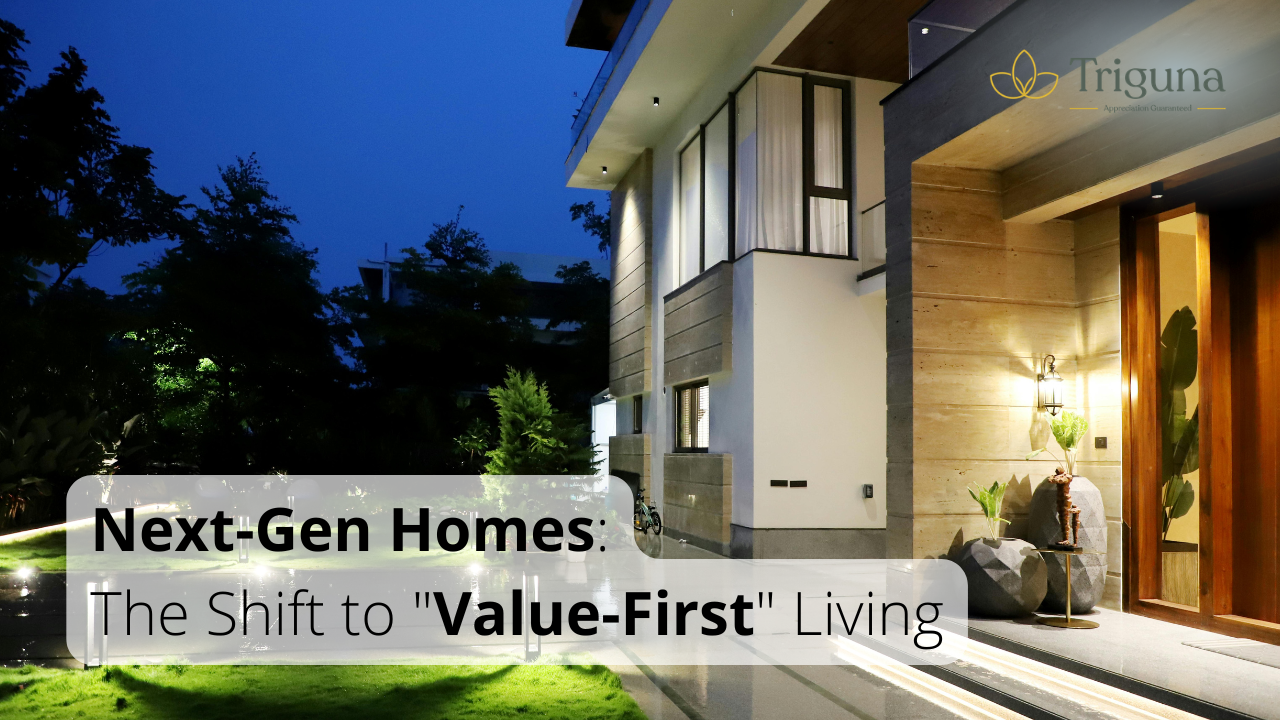
Bangalore’s Next-Gen Homes in 2026: The Shift to “Value-First” Living
Bangalore’s housing market is changing rapidly as 2026 unfolds, shaped by new buyer expectations and major infrastructure development. Based on last year’s data, housing demand is converging around three clear residential formats driven by technology adoption, sustainability concerns and lifestyle preferences. While the city remains India’s tech capital, its residential landscape has fundamentally shifted from volume-driven growth to value-driven exclusivity; and buyers are increasingly choosing homes that offer future readiness, flexibility and community living rather than ‘Just’ location.
The Broader Market Context
Bangalore’s residential market continues to expand despite affordability pressure in the mass segment. The city’s overall residential sales are forecast to expand by 3–5% in fiscal year 2026, supported by steady demand in mid-income and luxury segments, driven by professionals, NRIs and high-net-worth individuals (HNIs).
1. Demand Shift: Value Over Volume
Bangalore’s housing market is witnessing a clear shift from affordable, volume-driven housing to value-led premium living. According to JLL India’s 2025 analysis, homes priced above ₹1 Crore now capture approximately 63% of the total market share, a significant jump from previous years. Conversely, the affordable segment (<₹50 Lakh) has seen sales contract by nearly 30% as developers pivot to higher-margin projects. While overall unit sales saw a marginal dip (~1-5% YoY), the total value of sold inventory surged by 11%, driven by future ready and amenity-rich homes.
As a result, supply in the affordable segment is shrinking, while mid-premium and luxury homes continue to see strong demand. Developers are increasingly launching ₹2 crore and above projects, particularly in North Bangalore, Whitefield and Sarjapur Road, where sales absorption has been strong. As highlighted by reports from ANAROCK and Knight Frank, this signals a transition from quantity-focused development to quality-focused offerings.
These trends clearly point to a K-shaped growth pattern in Bangalore’s housing market:
- Luxury segment is accelerating: Faster sales, higher ticket sizes, and strong launch pipelines.
- Affordable segment is contracting: Rising land prices and EMI affordability challenges have reduced new supply.
2. Strong Price Growth Across Key Segments
Bangalore has recorded one of the strongest residential price growth rates in India, especially in the mid and premium categories. According to ANAROCK Research (2025), mid and premium home prices have risen by approximately 62%, the highest among major Indian cities.
In 2025 alone, city-wide residential prices grew by an average of 9–11%, with certain micro-markets experiencing even sharper appreciation. Today, average residential prices across Bangalore range between ₹8,000 and ₹10,000 per sq. ft., while premium localities’ prices are somewhere around ₹11,000–₹13,000 per sq. ft. or higher.
3. Infrastructure as a Growth Catalyst
Large-scale infrastructure projects are playing a crucial role in reshaping Bangalore’s residential landscape. Developments such as the Peripheral Ring Road (PRR), Namma Metro Phase II and III expansions and the Satellite Town Ring Road (STRR) are improving connectivity and opening up new residential corridors.
These infrastructure upgrades are reducing commute times, improving access to employment hubs, and driving housing demand in emerging suburbs. As per state infrastructure updates and real estate reports, connectivity-led development is expected to remain the biggest growth driver for Bangalore’s residential market heading into FY 2026.
What Defines “Next-Gen” Homes in 2026?
The “2BHK near work” mindset is being replaced by a demand for holistic lifestyle ecosystems.
1. Smart, Tech-Enabled & Sustainable Homes
Smart & Tech-Integrated Ecosystems is no longer just about a smart lock. In 2026, “tech-enabled” means integrated community management. Buyers are demanding app-based control for everything from visitor management to HVAC scheduling and EV charging station availability.
According to Economic Times and JLL India residential outlook reports, most new mid-premium and premium launches in Bangalore now integrate IoT-enabled automation, including app-controlled lighting, security systems, climate control (HVAC) and energy monitoring.
At the same time, sustainability has moved from being a ‘value add’ to a baseline expectation. As reported by Knight Frank India, buyers are actively seeking homes with Solar power integration, Rainwater harvesting and water recycling systems, Energy-efficient construction and green certifications, Centralized waste management and other sustainable living solutions.
These features are particularly prevalent in gated communities and premium developments, where developers are responding to environmentally conscious buyers and rising utility costs. The combination of smart technology and green infrastructure is emerging as a key driver of both end-user demand and long-term resale value.
2. Community-Centric & Mixed-Use Developments
Another defining trend for 2026 would be the rise of community-oriented, amenity-rich projects. According to CBRE India and Hindustan Times Property, buyers increasingly prefer residential environments that support wellness, social interaction and convenience.
Key features shaping this segment include:
- Large green open spaces and landscaped parks
- Fitness zones, walking tracks, other sports amenities
- Children’s play areas and shared community lounges
- Integrated retail, cafés, co-working spaces and daily-use services
Mixed-use townships, which combine living, working and leisure spaces, are gaining traction across North Bangalore, Sarjapur Road and peripheral growth corridors. This segment is mostly popular among families where they have school going kids and old age members. Media reports note that such developments reduce commute dependency while offering a more balanced lifestyle; a priority that has remained strong post-pandemic. And hence again Next-Gen homes.
3. Villas, Row Houses & Plotted Developments
There is a surging appetite for land. Plotted developments and gated villa communities are witnessing demand growth of 18–28% YoY, particularly in peripheral zones.
Beyond apartments, 2026 may witness sustained demand for low-density residential formats such as villas, row houses and plotted developments. As highlighted by The Economic Times and Anarock Research, this segment is being driven by families, business owners, NRIs and second-home buyers seeking space, privacy and customization.
These formats are particularly popular in North Bangalore (near airport and STRR corridors), Sarjapur Road and Hosur Road belts. Plotted and villa developments appeal to buyers who want the flexibility to design their homes, lower density living and potential long-term appreciation as infrastructure expands. Industry reports indicate that this segment also benefits from strong land-led capital appreciation, making it attractive to both end-users and long-term investors.
Housing Demand Outlook for 2026
In 2026, Bangalore’s housing market is clearly moving toward quality-led demand. Next-generation homes are larger, smarter and more sustainable, with buyers prioritizing technology, green design and community living over mere location.
For investors, North Bangalore remains the standout corridor, supported by airport-led development, metro expansion and long-term commercial growth. At the same time, premium and luxury homes continue to attract strong interest from HNIs and NRIs, reflecting a broader move toward high-quality living.
Buyers in 2026 face a clear trade-off: choose central locations at a premium or opt for emerging corridors that offer better lifestyle value. Overall, the year presents strong opportunities; provided buyers balance aspirations with infrastructure readiness, maintenance costs and long-term value.
